
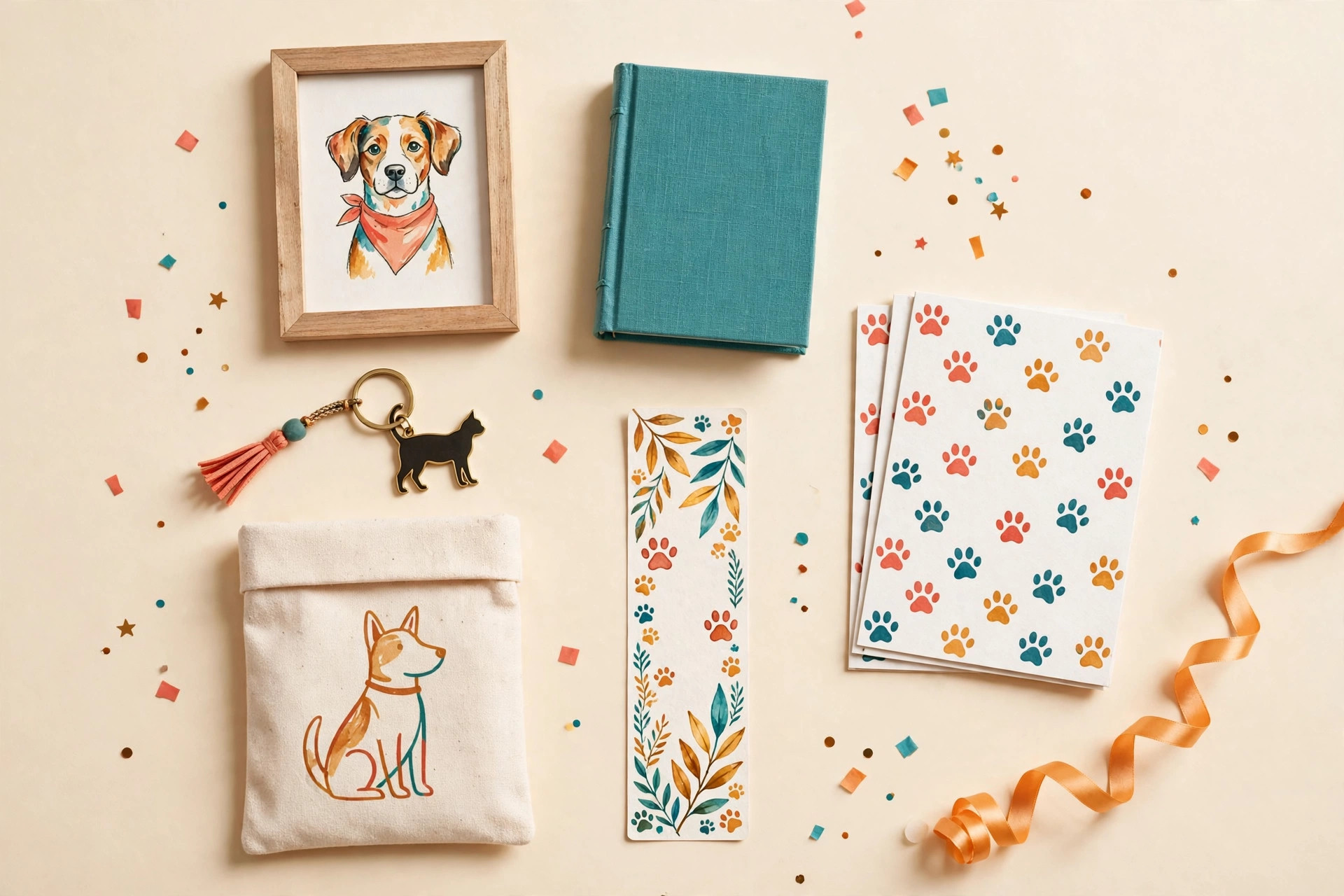
Their camera roll is mostly one animal. Their best stories begin with that animal. You have a strong gift clue—but it does not mean you should buy the animal a surprise diet, outfit, or toy.
A gift for the human can celebrate the relationship without guessing at the pet’s needs. Here are seven directions, with the details that make each one worth considering.
These are gift concepts rather than hands-on product reviews. We have not tested specific sellers or verified current prices. For custom orders, check the proof process, delivery estimate, and returns policy before paying.
Quick choice guide
| Recipient | Consider | Main detail to confirm |
|---|---|---|
| Loves displaying pet photos | Custom portrait | Artist style and image requirements |
| Prefers practical gifts | Illustrated pouch | Size and whether they need another |
| Enjoys keeping memories | Pet photo book | Photo access and layout time |
| Likes subtle accessories | Silhouette keyring | Species, shape, and hardware |
| Already owns lots of pet merchandise | Small custom print | A specific moment, not a generic slogan |
1. A portrait with the pet’s actual expression
The most personal detail might be a crooked ear or an expression of permanent disappointment. Give the artist a reference that shows it, rather than requesting a generic version of the breed.
Best for: someone who displays photographs or artwork.
Before ordering: check whether the purchase is a digital file or a physical print, whether framing is included, and how revisions work. A tiny preview on a phone is not enough to judge a large print. If you do not know their decor, choose a small format or let them approve the style.
2. A miniature photo book of everyday moments
A book about the cat’s favorite cardboard box can feel more personal than a formal portrait. Use a short theme: naps, walks, window watching, or the first year together.
Best for: someone with a shared collection of pet photos.
Before ordering: use photos you have permission to use, check print previews for cropping, and proofread captions. Do not copy images from private accounts without asking. Leave time for layout and printing instead of treating it as a last-minute purchase.
3. A keyring based on a recognizable silhouette
A simple outline can acknowledge the pet without putting a large photograph on everything. An unusual ear shape or a curled tail may carry more meaning than a stock paw print.
Best for: someone who likes small, understated accessories.
Before ordering: check scale, material, attachment hardware, and engraving limits. Keep public-facing engraving minimal; a gift does not need to display personal contact details. This is an accessory for the human, not a substitute for pet identification.
4. A pouch showing their favorite species
A sleepy rabbit, dramatic dachshund, or suspicious-looking parrot can turn a useful pouch into a private joke. Match the animal and the recipient’s taste rather than assuming all pet lovers want loud slogans.
Best for: someone who organizes a work bag or travel kit.
Before buying: check interior dimensions, lining, closure, and care instructions. Decide what the pouch is meant to hold; a cute print does not compensate for an unusable size.
5. A custom illustrated bookmark
For a reader, the pet can peek out from a book even when the real animal is busy sitting on it. The idea works particularly well when you know both the pet and the person’s reading habit.
Best for: a pet lover who reads physical books.
Before ordering: check thickness and how any hanging parts attach. Treat it as a human accessory and store it accordingly. If they read only on a screen, choose a different format rather than giving them a new habit.
6. A print of a very specific pet moment
Instead of another general portrait, commission or create a small illustration of the dog guarding a sock or the cat occupying a laptop. The scene tells a story that belongs to the recipient.
Best for: someone who already has a formal pet portrait.
Before ordering: confirm the moment is a happy one, supply clear references, and check the artist’s proof and usage terms. Avoid turning a difficult health or behavior episode into a joke.
7. A set of illustrated correspondence cards
Cards featuring their pet give them a way to share the obsession with friends. A restrained illustration and blank interior can work for thank-you notes, birthdays, or everyday messages.
Best for: someone who actually sends handwritten notes.
Before ordering: check card size, paper finish, envelope inclusion, and minimum quantity. Start small if you are unsure they will use them. Personal stationery is less useful for someone who communicates entirely by text.
When to ask instead of surprise
Custom gifts require accurate details. If you cannot confidently spell the pet’s name or choose an appropriate photograph, ask. You can preserve some surprise by offering a choice of two styles without revealing the final design.
For a memorial gift, ask whether they would welcome one. A portrait can be meaningful, but the timing and format should belong to the person receiving it.
Leave animal-care decisions with the owner
Food, supplements, fitted equipment, and toys require knowledge these human-focused gifts do not. If the recipient specifically requests one, ask for the exact item instead of substituting something that looks similar.
Also be careful when adding flowers or a plant to the package. Check the exact plant and relevant animal species using the ASPCA’s toxic and non-toxic plant directory. The directory cautions that it is not exhaustive.
A gift that shows you noticed
The strongest detail is often something small: the correct markings, a familiar sleeping position, or the nickname the family actually uses. Choose one of those details, put it on an object the person would use anyway, and resist adding more.
Browse the pet lover gift guide for this category, or explore odd gifts for people who have everything.